
Does the Emperor Have No Clothes?
Analyzing NYC Mayoral Candidate Zohran Mamdani's policies

Hey everyone, welcome to Mind, Macro & Markets. I decided to brand my Substack articles into a weekly newsletter. The publication is going to focus on delivering insights into philosophy, economics (whether that’s Macro or specific finance analysis), and politics. This is the first post for Mind, Macro & Markets:
“The Emperor walked under his high canopy in the midst of the procession, through the streets of his capital. All the people standing by, and those at the windows, cried out, “Oh! How beautiful are our Emperor’s new clothes! What a magnificent train there is to the mantle; and how gracefully the scarf hangs!” No one would admit these much admired clothes could not be seen because, in doing so, he would have been saying he was either a simpleton or unfit for his job. “But the Emperor has nothing at all on!” said a little child. “Listen to the voice of the child!” exclaimed his father. What the child had said was whispered from one to another. “But he has nothing at all on!” at last all the people. The Emperor was upset, for he knew that the people were right. However, he thought the procession must go on now! The lords of the bedchamber took greater pains than ever to appear holding up a train, although, in reality, there was no train to hold, and the Emperor walked on in his underwear.”
Hans Christian Anderson “The Emperor’s New Clothes”
On July 4th, I wrote my most contentious post on Substack about Zohran Mamdani, labelling him a left-wing populist. However, that was just a label I tossed around related to his presence in the media without analyzing his policies. The New York City mayoral election is early this November, so I hope to write a series about the policy platforms of each candidate. In this lengthier post, I will explore Mamdani’s policies and examine their economic feasibility. Beginning with Library Funding Commitment, I will then transition to small business deregulation, and then discuss his strength as a politician. Then, I will evaluate his plans to subsidize bus fees, freeze rents, establish city-owned grocery stores, and raise NYC’s minimum wage.
Library Funding Commitment
In 1901, Andrew Carnegie pledged $5.2 Million (over $180 Million in today’s age) to build free, publicly accessible libraries across all of New York City. His aim was to grant library access to every New Yorker regardless of their borough or neighborhood. Over a hundred years later, Carnegie’s libraries are in an awkward position — funding has become messy, manipulated by mayors to get budget concessions. In response, Mamdani wants to keep the original vision and has pledged to not defund the New York Public Library.
This opposition to the defunding of city libraries and their usage as a bargaining chip in city policy-making is one of my favorite parts of his campaign. As someone who loves the New York Public Library, I am inclined to support this policy. Since Library funding was threatened with cuts several times in the past, Zohran states 0.5% of the city’s budget should stay permanently allocated towards library funding, so it doesn’t get threatened again.
According to an analysis by David Woloch, budget negotiations follow a “dysfunctional dance”. The Mayor realizes the City Council will ask for a service improvement, so they pressure the City Council with proposed cuts. This forces the City Council to move to maintain the budget. One year ago, Eric Adams introduced a budget that would reduce library funding by $58.3 million. This led to the NYPL using social media to rally support and avoid defunding. The lengths taken to restore funding in response to Adams underscores the value New Yorkers place on the NYPL.
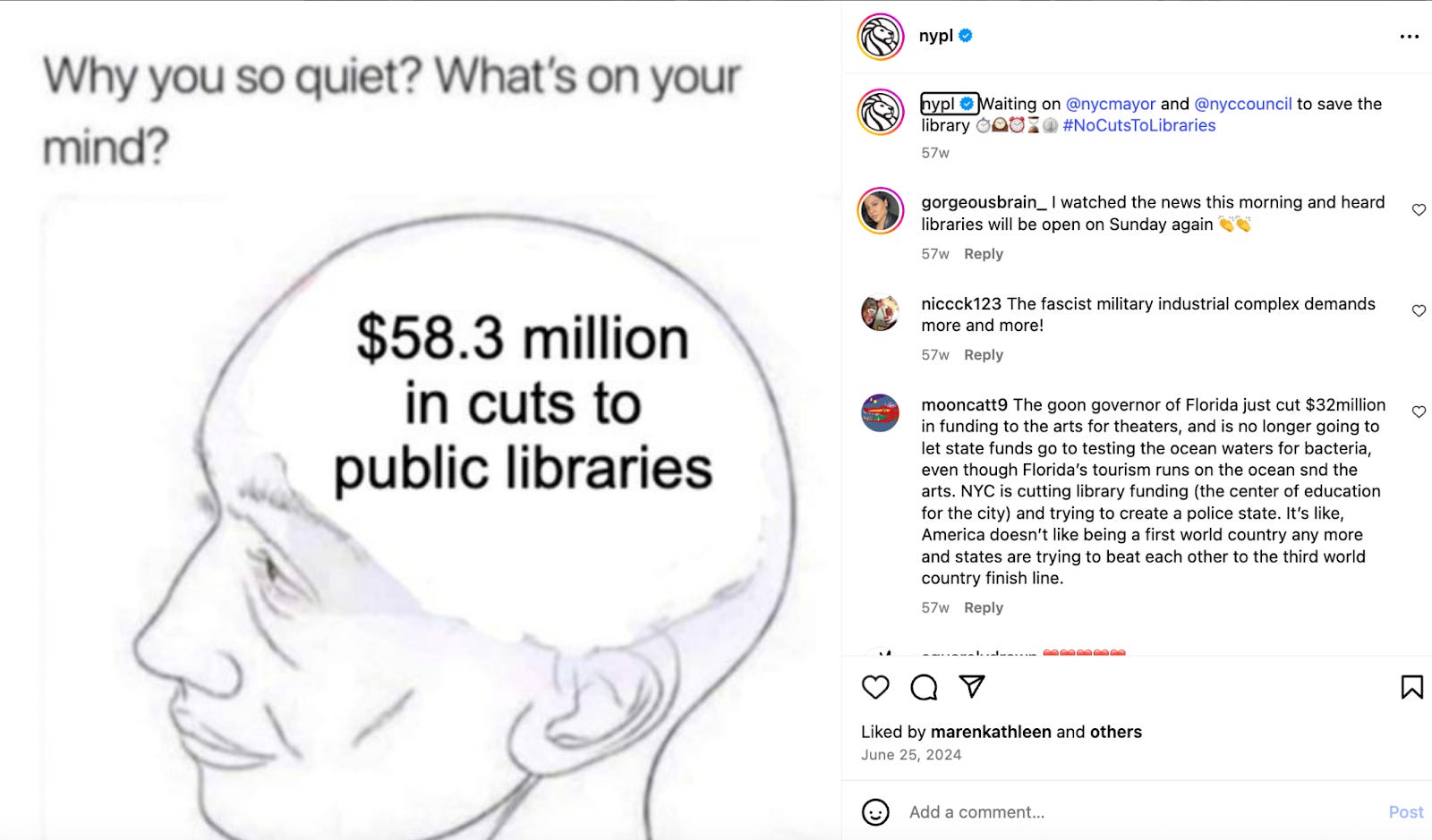
Source: New York Public Library Instagram
Even if keeping libraries seems like a good policy, it’s relevant to find out what the opportunity cost of library funding is. Some examples of opportunity costs pertain to Mamdani’s other promises — money allocated to baby baskets, freeze rent programs, and city-owned grocery stores. Just this year in 2025, the city has allocated an unprecedented $523 million to libraries (Arts in Education Roundtable). Ultimately though, since this is less than a percentage of the entire NYC budget, the opportunity cost objection isn’t viable.
As well, past examples of libraries have yielded significant improvements. A 2017 Study by the University of Texas, found nearly 5x returns on library investment in Texas broadening access to resources, programming, services, and technology. That goes to show Mamdani’s library policy could commit New Yorkers to live Carnegie’s century old dream of universal NYC library access.
Small Business Deregulation
I find it interesting that a democratic socialist would align with decreasing business regulations — a key principle in limited government. That said, it’s not a complete contradiction — Mamdani’s principle is to clear red tape and make starting a business easier for the common man. NYC is home to 183,000 small businesses as of 2023 (NYC EDC). That may sound like a lot until you think about how many businesses die because of the six thousand Rules & Regulations(RCNY) within bureaucratic city laws. For example, city code requires 56 and 52 (Institute of Justice) discrete tasks to open a barbershop and a restaurant. Surely, Mamdani’s deregulation would spur small business activity making New York City’s economy even stronger.
Political Strength
I believe Mamdani is a very effective communicator. He showcases a strong future for the Democratic Party through his charisma and eloquence. Uniquely, he brings a breath of fresh air in U.S. politics and holds an ability to engage voters shown by videos of him on the street talking to New Yorkers. Reading Mamdani’s interview with Derek Thompson, I personally resonate with his vision of ending New York’s reverse exceptionalism (“Oh that wouldn’t work here”), and reclaiming “quality of life as a left wing concern”.
Ultimately, I think his politics may drive a sense of reform within the Democratic Party after they were unable to mobilize voters in 2024. Right now, the Democrats seek to command a stronger base as Republicans are facing backlash over the OBBB. Hopefully, Mamdani’s citizen-centric politics can be a good model for future Democrats. As a child of immigrants into the U.S, it’s truly commendable to see Mamdani command the support and following he’s gotten.
Free Bus Proposal
I’ll be honest, I hate taking buses in New York City. I live in the Stuytown area and am about a 10 minute walk from a subway station. The one time I took a bus — because I was running late to class and Google Maps said the trip would be 15 minutes —the bus ended up not leaving the stop for 10 minutes and sauntered around for another 30.
Mamdani wants to fix that, citywide. Mamdani argues that making buses free which sounds counter-intuitive, but it’s based on the fare collecting in buses being what slows them down. His proposal theoretically would give me back those 15 minutes I lost that day to the hundreds of thousands/millions of New Yorkers that take the bus daily. Furthermore, Charles Komanoff estimates that a free bus system would lose $630 million in foregone revenue, but create nearly $1.5 billion in savings from bus riders and from positive externalities such as motorcycle, bike, and walking savings.
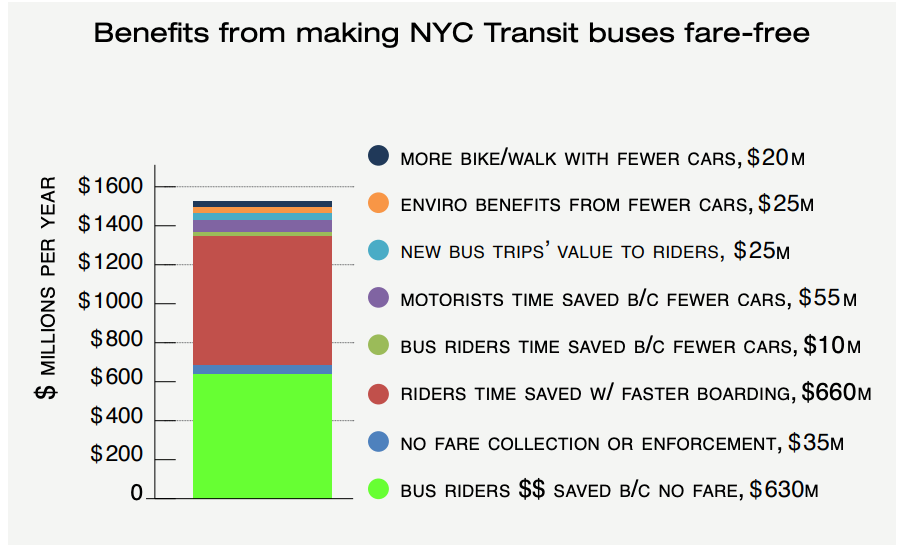
Source: Charles Komanoff “Eliminating NYC Transit Bus Fares: An Appraisal”
However, as I was thinking about this policy, I remembered something from school that may object to this policy. In Planning Order, Causing Chaos: Transantiago, Michael Munger examined the Chilean bus system and how a planned system ultimately failed. Santiago’s initial bus network was mainly privatized — bus rides were paid per passenger and routes were parallel to the metro. So, that led to high accident rates near stops as bus drivers raced each other to pick up the most amount of people. In response, the government shifted policy giving drivers an hourly rate and shifting routes to be close to metro stations. Now, since drivers were getting paid either way, they had no incentive to pick up passengers and traffic became congested around the Metro.
I bring up the Santiago Chile bus system example because it underscores the importance of incentives. Applied to Mamdani’s system, driver’s incentives change. Currently, drivers are paid an hourly wage, but passenger count matters to keep bus routes. If drivers don’t have to take time to collect anymore, why wait at a stop at all? What does it matter to them if they miss someone? If someone drives a car in New York because they like speed and don’t want to be with other strangers, why would they switch? If most people hop the subway and don’t pay on the bus right now anyway, what good would this program even do?
Freeze Rents Policy
In 1961, a city-wide housing resolution restricted New York potential housing so much the maximum population capacity fell from 55 to 11 million. The goal of the legislation was to get past 45-year old zoning regulations, so New York could address evolving population and economic needs. As supply quickly decreased though, home prices shot up. The graph below show the change in condos over time in the New York City area, and reveals New York home prices have tripled in the last 25 years. This has frustrated homeowners making it difficult to buy homes/pay rent, so Mamdani proposes to freeze rents.
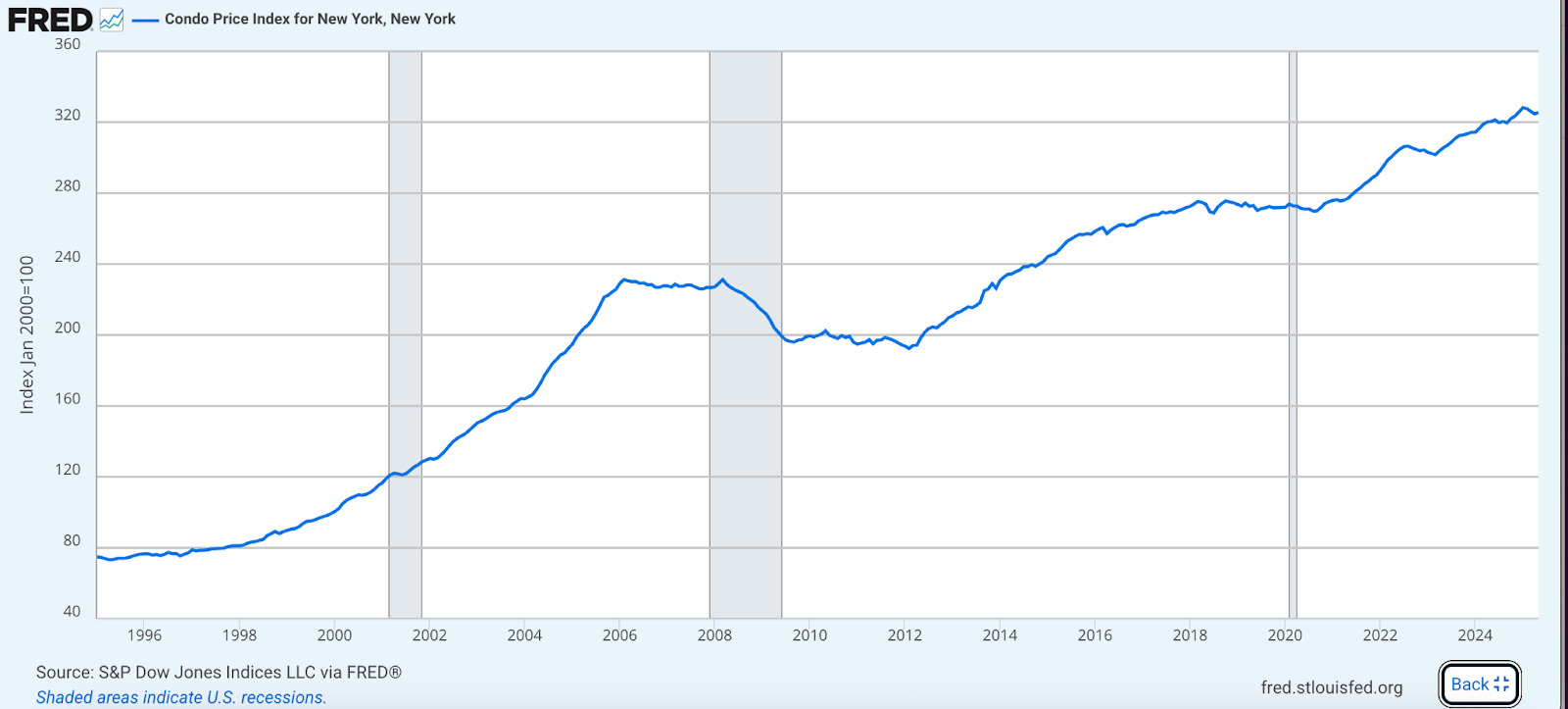
Source: St Louis Fred
High Rent in New York City has been contentious for years. In 2019, when Andrew Cuomo was Governor of New York, he passed legislation restricting landlords’ ability to raise rents. Landlords responded by removing tens of thousands of housing units from the housing market. Evidently, this shows the NYC housing market will not react positively to any freeze Mamdani attempts.
Moreover, a Brookings Institution review claims rent control transfers wealth from property owners to current tenants in the short term, but incentivizes landlords to remove units from the rental market which reduces housing supply. When landlords lose a revenue stream, it’s in their best interest to leave the market and pursue a more profitable venture. When Cambridge, Massachusetts repealed rent control, the value of de‑controlled properties increased 45% and neighboring properties benefited (Brookings). In San Francisco, tenants under rent control were 19% less likely to move, but landlords responded by taking units off the rental market (Brookings).
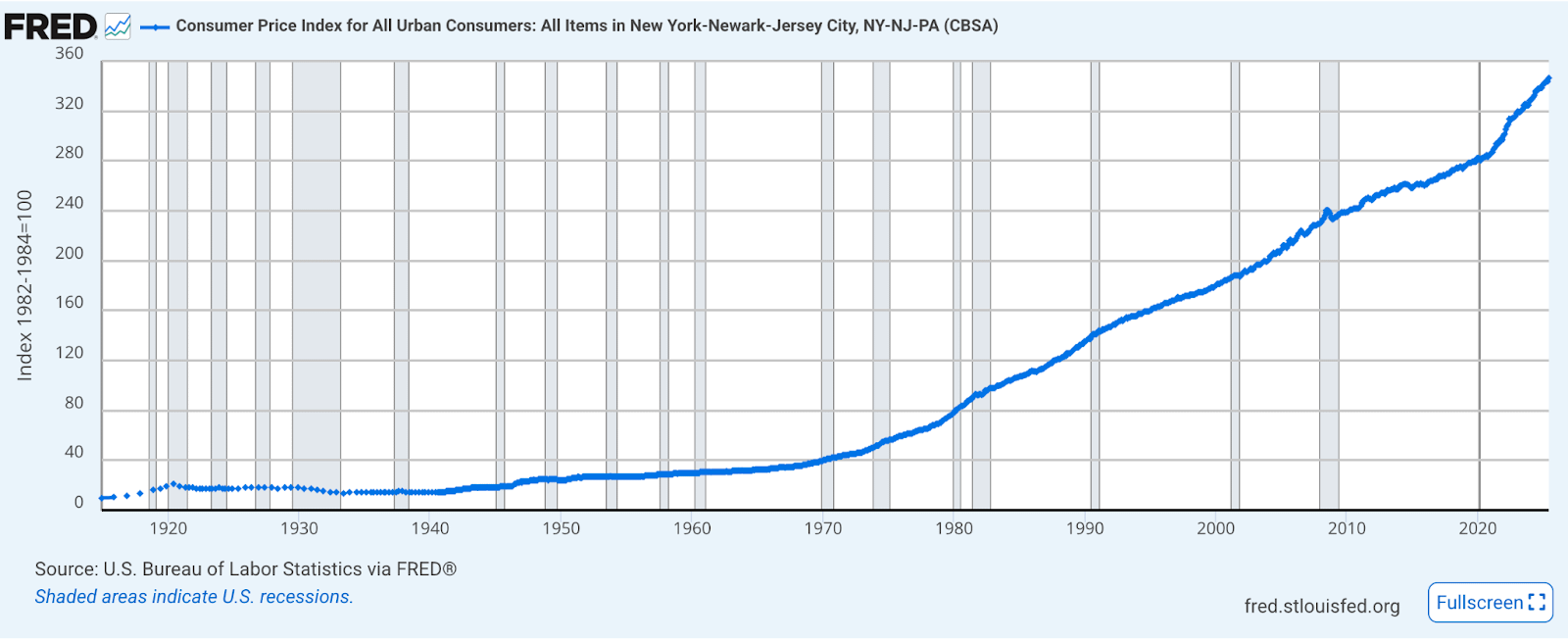
Source: US Bureau of Labor Statistics via FRED
Currently, Eric Adams explained that rent increases supported the rising costs of maintaining buildings. As shown in the above graph, prices for insurance, fuel, and grocery items have tripled over the last three decades. Therefore, rent prices would follow. Additionally, according to Politico, the cost of maintaining a building in NYC has gone up by 28% in the last five years. After Cuomo’s 2019 legislation, Mark Willis, senior policy fellow at NYU’s Furman Center, claimed that the restricted rent increases would be "sufficient for buildings primarily reliant on revenue from rent-stabilized units”, so landlords would resort to other methods to earn revenue.
Furthermore, Mamdani proposes to “build the housing New Yorkers need”. But how will he do that? In the interview with Derek Thompson, he argues that since landlords have other means of extracting profits such as Individual Apartment Improvements, they don’t stand to lose much. What Mamdani doesn’t factor in is that IAIs are capped at $30,000 over a 15 year period with some narrow cases allowing for $50,000.
How will he tackle logistical and political hurdles to build the housing? Where will units be placed? Will it be public housing or public-private housing? Leaving an empty promise of idealism leaves me unconvinced.
I get it. Rent in NYC is annoying. But freezing the rents isn’t the solution.
City-Owned Grocery Stores
Yes, I know groceries are expensive in New York. As a student living in the city, I try to budget my groceries responsibly, but I find myself feeling like I am down at least a Ryanair ticket most of the time. Mamdani’s promise is to create city owned grocery stores focused on keeping prices low, and creating a public option for groceries. He plans to put one grocery store within each bureau.
The first issue with public grocers is the set up itself — with razor thin margins, the stores will have to sell all of its products to not be a loss. This is because by attempting to sell groceries at extremely low prices, they force themselves to extremely low profit margins. Finally, on the other side of the spectrum, even if the store sells all its products, it will still isolate New Yorkers. The amount of groceries sold is limited, so most New Yorkers still wouldn’t get access to groceries.
In Erie, Kansas, the Erie Market loses tens of thousands of dollars a year which made it require volunteer support and rely on local produce donations (City Journal). In St. Paul, Kansas, a community-run store eventually turned a profit, but only with volunteers and donations. History shows us these models rarely scale and are less effective than targeted subsidies, transport services, or partnerships with local grocers.
However, in Nelson Eusebio’s opinion editorial about these stores, he advocates for deregulation of grocery stores, creation of a rent relief program for landlords/tenants, and relieving grocery stores of insurance premiums. Without concrete definitions of these programs, I can’t fully evaluate these suggestions, but they are promising. Tying Zohran’s deregulation program to this, I think making it easier for private citizens to set up a grocery store and place abundant food could legitimize food security for every New Yorker without the public grocery.
Minimum Wage
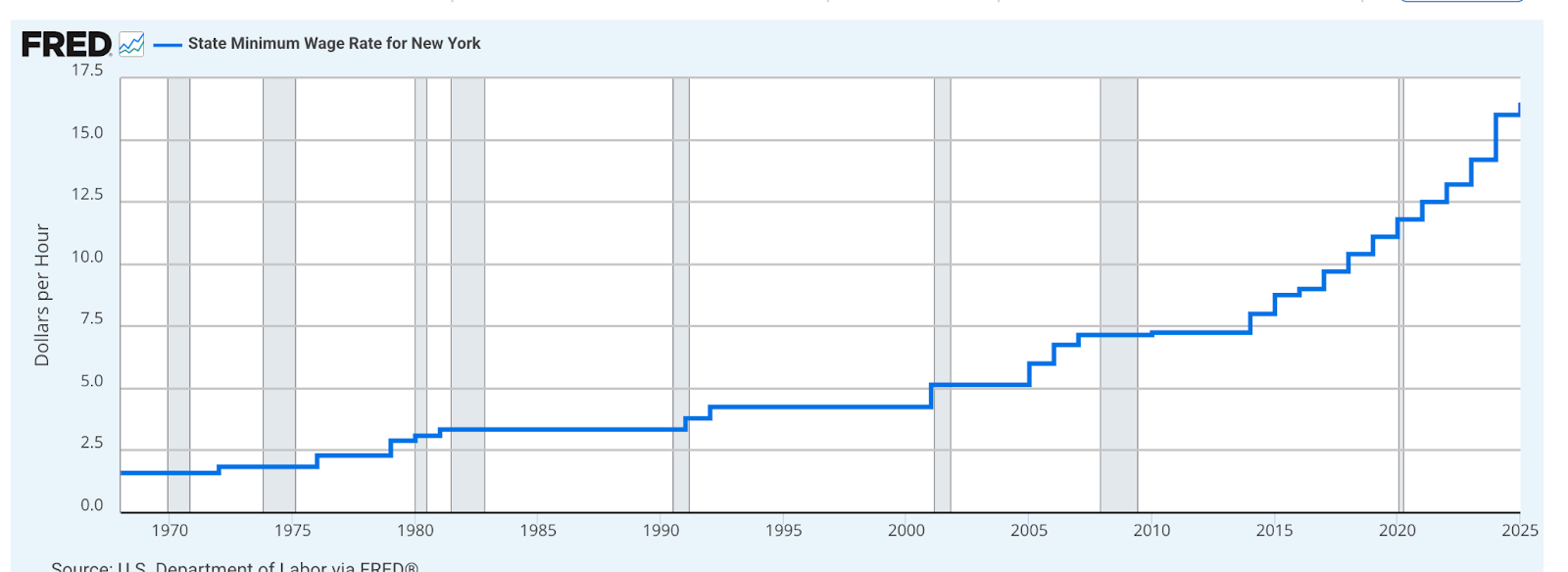
Source: St. Louis FRED NYC Minimum Wage
One of Mamdani’s most popular promises hinges on raising the minimum wage from $16.50 to $30. The graph above illustrates the rise of the NYC minimum wage — rising from $5 to $16.50 in two decades. At its core, a sizable $13.50 increase over a four year span would be inflationary and increase unemployment.
Today with LLMs like ChatGPT, Claude, and Gemini, everyone is fearing how AI could cause massive job losses. Turning to minimum wage’s unemployment effect, Yale Brozen nearly 60 years ago, gave us stark insight way ahead of his time — automation won’t displace jobs, but firms not wanting to pay higher wages might. In Mamdani’s case, hiking the minimum wage so aggressively within a four year period is bound to accelerate New York’s unemployment rate.
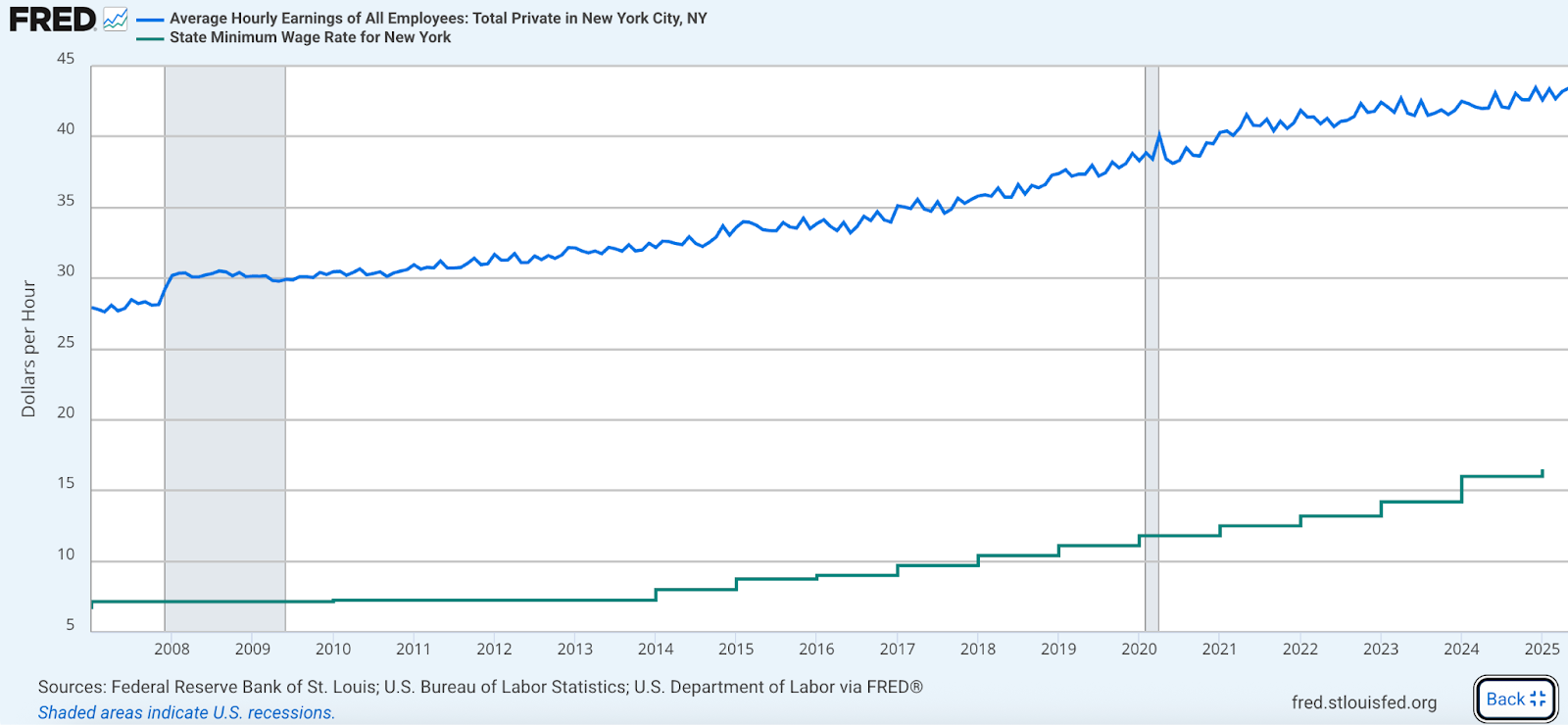
Source: St Louis FRED
On the inflation side, Mamdani’s 88% minimum wage increase creates both cost-push (firm-based) and demand-pull (consumer-based) inflation. The graph above shows the average New York City hourly wage rate versus the minimum wage. Looking at the graph, increases in the minimum wage seem to have frequently correlated with an increase in average hourly wage rates, so pushing the minimum wage is bound to have an impact on the average wage rate.
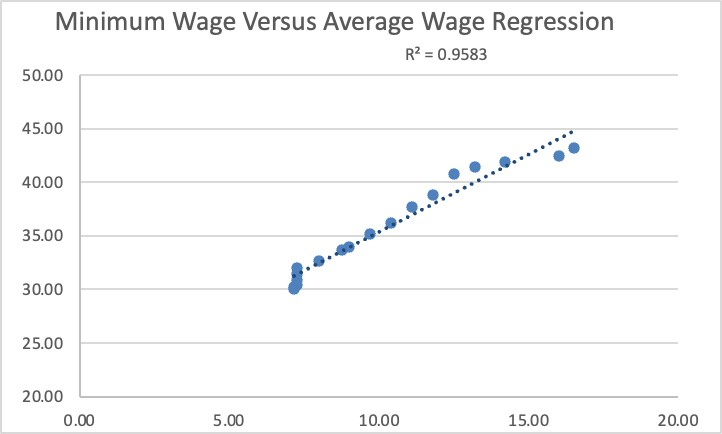
Source: NYC Minimum Wage and NYC Average Wage Data from St. Louis FRED
Testing the minimum wage and the average wage data gave me a F-statistic of nearly 284, implying a strong casual relationship between the minimum wage and the average wage rate. Running a regression analysis, I determined that Y=1.5604x+20.141 where x is minimum wage, and Y is average wage. The strength of this relationship held a 95.83% explanatory power, so the minimum wage explains about 95.83% of the variation in hourly wage. Solving the equation for Y=30, the model tells us the new average hourly wage would be $66.95, a near 55% increase from the current rate. Even though an actual increase may not be as exaggerated as the model suggests, we can infer significant cost-push inflation from Mamdani’s campaign.
A potential explanation for this is as businesses pay more for minimum wage work, they might increase wages all-around as workers would feel relatively under-compensated. Since businesses now face higher costs, in order to maintain profits, they pass these costs down by raising consumer prices. There is also demand-pull inflation from the higher wages workers receive. When workers receive their higher wage and spend more within the economy, over time their purchasing power declines as suppliers raise their prices in response to limited supply.
Conclusion
Returning to the quotation at the beginning, the Emperor having no clothes was used rhetorically by Robert C. Byrd to describe President W. Bush’s foreign policy regarding the War on Terror. At the time, this rhetoric was used to argue the President was constructing a false threat.
Extrapolating Byrd’s foreign policy critique to New York City politics may shed a unique light on Mamdani. As an aspiring executive, Mamdani is at his best when looking at issues pragmatically. His proposals to slash small business red tape, safeguard library funding, and eliminate bus fares look promising. Unfortunately, his flagship policy recommendations —such as rent freezes, drastic minimum wage increases, and city-owned grocery stores — are overtly ideological and half-baked. Ultimately, Mamdani and his policies embody the crux of the metaphor. Although Mamdani’s modern, social media-friendly style as a politician reflects the persuasion and likability of an Emperor, he lacks the “clothes” in the form of concrete policy to substantiate it.
This is very interesting macro thinking on free stuff